Tuesday, January 6, 2015

Youth Activist Picks unanswered issues in Biya's New Year Address

Buea, Cameroon—Read  the response of the Cameroon Country Coordinator of the Organization of African Youth (OAYouth), to the Head of state’s 2015 New Year address to the Nation last December 31, 2014. (Unedited)

RESPONSE TO END OF YEAR SPEECH BY PRESIDENT PAUL BIYA
Jude Thaddeus Njikem
As a youth activist, I make it a point of duty to follow up on policy development and major pronouncements that might have an impact on young people. I therefore listened to the speech by the President of the Republic of Cameroon and read the transcript and I felt oblige to write, at least since the Cameroon National Youth Council is unable to comment on our behalf.
As my friend Nadege Yoko puts it, it was a speech well made, the president made very interesting pronouncements about the importance of peace and development, which are intrinsically linked.
Let’s look at the other unreported issues;
Appreciate the efforts of BIR for fighting the insurgency in the North. Greatly appreciated, our hearts go out to the fallen soldiers who have lost their lives in the fight. We pray, your families find consolation. You have proved to us that you can be more patriotic than some of us who sit and complain like I am doing.
What I don’t understand is why a speech such as this, which is supposed to give insights to the common man, on the state of the country-is empty with statistics. We don’t hear how much of public investment budget was spent, how many schools , bridges, hospitals, were built or teachers recruited, farm to market roads tarred, we don’t know which effort at alleviating poverty has been successful and what strategies will be deployed subsequently.
Malaria, one of the main course of maternal deaths is free but Président Paul Biya, would you please instruct the Ministers of Health, Communication to reiterate this information to all stake holders and communities in a country where there are more private clinics/hospitals than state owned,? How does the malaria treatment go in those private hospitals? Is it the same as with education section where primary education is free in government run schools but expensive in private run schools?
283443 new jobs created in 2014? It would be quite interesting for the Minister of Employment and Vocational Training to break it up for us as well as in terms of underemployed and percentage of unemployed youths.
What more did the recent triennial appraisal report say about Growth and Employment Strategic Paper?
What steps have been taken to use up the Public Investment Budget?
We were unable to use 1000 billion in 2014, can we use more in 2015? Public contracts marred by poor execution, late deliveries etc, how will this be addressed in 2015?
Industrial development/big companies are coming, we clap our hands and welcome them, what about starting small businesses for our youths?
When will the Small and Medium Size Enterprise bank be eventually put in place and what steps have been taken to promote startup and support Small and Medium Size Enterprise?
Moving from a state-dominated economy to a more liberal system would mean prices of goods and services be moderated by global market prices? I wonder however why despite the fact that global petroleum prices have faced its lowest, we are still tight to the increment signed by Prime Minister Yang, and does commonsense not tell us it is a state dominated economy?
"...I make it a point of duty to follow up on  policy development"
As a response mechanism to Ebola outbreak, we closed down our borders with Nigeria, what is our emergency response mechanism, aside from shutting down our borders? How prepared is our state?
With regards to the Anti – Terrorism Law, I reserve my comments to a later date, at least when my team would have advised me but one question that lingers is “why try civilians in military courts?” in my opinion, we have shifted from the democratic institution we wanted to build and have put our citizens at the fore of intimidation and entrapments
“man weh no know anything, make he lock mouth. No spit noting man tok like me”
Jude Thaddeus Njikem
Vice President and Cameroon Country Coordinator
Organization of African Youth

Friday, January 2, 2015

Boko Haram Has Suffered Heavy Human And Material Losses—Biya

Yaounde, Cameroon--In his New Year Message to Cameroonians on December 31, 2014, President Paul Biya said the dreaded Nigerian Islamist sect, Boko Haram has suffered heavy human and material losses in each of its attacks on Cameroon. See President Biya’s New Year message to the Nation below :
Paul Biya
Fellow Cameroonians,
My dear compatriots,
It was our hope, following a period of intensive political activity, that as 2014 was not an election year, we would be free to devote ourselves primarily to reviving our economic growth which, as you are aware, is a prerequisite for improving the living conditions of our populations.
Such was not exactly the case owing to the escalation of attacks against our national territory by the Boko Haram sect. Besides this, there were the criminal activities of armed gangs on our border with the Central African Republic.
Initially, the Boko Haram terrorist organization carried out raids to seize isolated hostages or loot public or private property.
Buoyed by their grip on north-eastern Nigeria, the so-called “jihadists” launched major attacks on the Far-North Region of our country, for instance, the attack on the workers’ camp of a Chinese company at Waza and the raid on Kolofata, resulting in several deaths and the abduction of many hostages.
This could not be tolerated. We therefore set up a response and prevention mechanism which quickly proved its worth. Since then, Boko Haram has suffered heavy human and material losses in each of its attacks. It is hoped that they would learn their lesson.
At this juncture, I would like to pay glowing tribute to our defence forces whose valour has been demonstrated in recent fighting.
I have had occasion to say that the Nation as a whole ought to mobilize and rally behind its defence forces.
Such seems to be the case by all accounts from our regions. I have most particularly appreciated the stance of our Muslim compatriots. They, like all the other Cameroonians, have clearly understood that this war is by no means based on religion. They have clearly understood that it is a response to external aggression by a terrorist organization that does not subscribe to the values of a fraternal society.
My dear compatriots,
The growing threats on our borders have prompted us to take measures to safeguard against their effects on our internal security. Such is the purport of the law on the suppression of terrorism which Parliament recently passed by a large majority. It is far from serving as a pretext for restricting civil liberties, as claimed by some ill-intentioned people. Besides, the instrument is very clear on this point.
Furthermore, faced with an upsurge in terrorist activities, most leading democratic countries have in recent years passed new laws to prevent terrorism. By so doing, they have complied with the recommendations of international organizations, particularly the United Nations and the African Union. Such is what we deemed appropriate to do. Therefore, our objective is to safeguard against any terrorist-related risk as far as possible. Every State not only has the right, but also the duty to protect its citizens. I am convinced that the vast majority of our compatriots do understand.
I would also like to recall here that Cameroon is not the only country facing this threat which knows no boundaries. Some of our neighbouring countries, namely Benin, Chad, Niger and Nigeria, are collaborating with us to form a united front against Boko Haram.
The United Nations Organization and several big powers, particularly the United States of America, Germany, France, Russia and China, also back us. I will be revisiting this issue before long.
It goes without saying that mobilizing the required resources for our defence means additional spending. As you are aware, the situation in the Central African Republic also warrants our vigilance on our eastern border. We are forced to host tens of thousands of refugees from this brotherly country. I take this opportunity to commend the valuable assistance we are receiving from humanitarian organizations. It is clear that our duty-bound solidarity has an impact on the budget. But, we must also understand that security has a price.
My dear compatriots,
As I said at the onset, we were obliged to prioritize the defence of the national territory, for, there can be no peace without security and no development without peace. Nonetheless, we have not relented in our efforts to revive growth. Now that our democratic institutions are fully functional, growth is the focus of our policy. As I stated earlier on, our growth is a prerequisite for a strong economy and, hence, our capacity to roll back poverty and progress towards emergence.
A quick evaluation of our economic programme shows that our first-generation major projects are either completed, nearing completion, or on track. Such is the case, in particular, for the Kribi Gas-fired Plant and Port, dams and hydroelectric power plants, as well as some road and various infrastructure projects.
Thanks to these projects, there is renewed activity in various sectors of our economy. The impact on employment and the improvement of living conditions is also visible. The year 2015 should therefore be characterized by the launching of second-generation projects in the energy, water, road and highway and transport sectors.
My dear compatriots,
Most of the major undertakings announced in my address on 31 December 2013 have been fulfilled.
1.We celebrated the FIFTIETH ANNIVERSARY OF CAMEROON’S REUNIFICATION last February in Buea with all the necessary pomp and solemnity. The town of Buea, which has been provided with various infrastructure, has been completely transformed. The impact of this celebration was also felt in neighbouring towns. This key moment of national unity is a milestone in our history.
2.I also promised substantial improvements in the health domain. These are now realities. Malaria treatment for children aged below five is now free. Our health map now comprises three new referral hospitals: the Yaounde National Emergency Centre, the Douala Gynaecology, Obstetrics and Paediatric Hospital and the Sangmelima Referral Hospital.
3.The employment spin-offs of our growth policy which I referred to a while ago have been confirmed. In 2014, 283 443 new jobs were created against 250 000 projected, as you would recall.
4.You would also recall that I underscored the need for Cameroon to have a viable emergency plan for the coming years. This announcement as well has been translated into reality. The said plan was adopted and launched during the Council of Ministers meeting held on 9 December. I will come back to this later.
My dear compatriots, 
Should we be content with these results which can objectively be considered positive? Substantial progress has been achieved as confirmed by the recent triennial appraisal report on the implementation of the Growth and Employment Strategy Paper. That being the case, I will simply say that we can and should do even better. I am convinced, as I pointed out last year under the same circumstances, that we must increase our growth rate at all costs. Are we sure we have done all we can? 
Take the case of investment for instance, which has so far been largely initiated by the State and reserved especially for anchor and social projects. Public Investment Budget allocations have increased considerably in recent years. In 2014, they represented about one-third of the overall budget, or approximately CFAF 1 000 (one thousand) billion. This is commendable. However, in terms of execution, there are hurdles and project implementation is often slowed down. I decried such under-utilization of budgetary appropriations. As you know, our needs are obvious and urgent. I am pleased to note that this year, there has been a marked improvement in contract execution rates which should increasingly match commitment rates.
Although in 2013 the public authorities, through Parliament, adopted major incentives for private investment, the latter still seems unable to take over from the State. 
However, there seems to be progress in this direction among local and foreign entrepreneurs thanks largely to awareness-raising campaigns by investment promotion bodies. This is proven by the recent signing of 13 agreements in the Ministry of Industry, worth CFAF 180 billion. 
I want to believe this is just the beginning. We do need an ambitious industrial policy. There can be no great country without industry. Even agriculture, which I love to say is the principal source of our wealth, is also expected to go “industrial”. 
It is understandable that the implementation of our major iron and bauxite mining projects, whose ultimate goal also is industrialization, is dragging as such projects are complex. Conversely, there is no plausible reason for our slowness in developing industries to process our agricultural commodities. 
Besides the benefits we could derive in terms of value added and employment, local processing will contribute towards rebalancing our foreign trade which is showing a structural deficit. 
In fact, our trade balance is characterized by a significant import surplus against exports which largely depend on the sale of three or four commodities whose prices are unstable. Our imports, for their part, mostly concern manufactured products, notably capital goods for our major projects. Obviously, it is difficult for us to restrict our purchase of capital goods. That, we understand. On the other hand, we should be able to limit the importation of the commodities we are able to produce. 
These remarks which I am compelled to make once more reflect the difficulty we are facing moving from a State-dominated economy to a more liberal system which is now the rule. The situation is such that sometimes we suffer the disadvantages of both systems. This, to me, explains the resistance to structural reforms which is stifling our growth revival efforts.
Some of these reforms concern our governance, particularly public finance. Significant progress has been made in this area and needs to be consolidated by ensuring budget sustainability, reducing subsidies as much as possible and reviewing the tax base. On the whole, our administration would stand to benefit by streamlining its procedures and, as I said recently and instructed, cutting down on its spending. 
My dear compatriots,
To jumpstart our growth, I have instructed the Government to implement a three-year “emergency plan”. Its objective is to achieve visible progress and measurable improvements in vital areas such as urban development, health, agriculture, roads, energy, low-cost housing and security. I expect the said plan to meet the most urgent needs of our populations nationwide.
This initiative is different from our Growth and Employment Strategy which will continue to be implemented by the Government. About CFAF 1 000 (one thousand) billion will be allocated to the plan. The implementation of this plan will determine whether we are capable of meeting the challenge whose outline and timeframe we have ourselves defined.
Of course, it is crucial for our country to meet this challenge. We have the wherewithal. 
My dear compatriots,
In a few hours, you will be happily celebrating New Year’s Day.
However, before that, let us spare a thought for our soldiers who have fallen defending our Fatherland. Let us spare a thought for those securing our borders, their grieving or anxious families and our compatriots who are suffering physical and psychological pain.
I would now like to extend to you all my best wishes for good health and happiness in the New Year.
Happy and prosperous New Year 2015!

Wednesday, December 31, 2014

New Year Address: Biya’s Lingering Legacy Of Unkept Promises

Yaounde, Cameroon—Like with the past years, Cameroonians will today again be glued to their TV and radio sets as from 8PM to listen to the Head of State in his traditional New Year address, which is usually presented on the eve of New Year.
Paul Biya

Most Cameroonians who have been listening to the octogenarian Head of State, at least for the past four years describe his New Year messages describe as prattle.
On the 31 of December last year, (eve of 2014), President Biya in an angry mode chastised the Philemon Yang led government for what he described as poor execution of the public investment budget.
The Head of State opened his address on a note of optimism saying Cameroonians have all reasons to feel satisfied with 2013 which has paved the way for excellent future prospects.
Given that Cameroon witnessed the first ever senatorial elections in 2013, a year in which the current municipal and legislative authorities were also elected; Mr Biya explained that “having put in place the Senate and local and regional authorities, the establishment of the Constitutional Council within a reasonable timeline will complete the institutional structure enshrined in our Constitution”. One year on; Cameroonians have been waiting for this promise to be fulfilled.
The Head of State noted that the Cameroon economic growth which was projected at 6.1% could only heed a dismal 4.8% which according to him is not however dramatic though calling on all and sundry to redouble efforts.
Still in the economic domain, President Biya noted that Private investments that can boast the economy remain inadequate. “We still need to improve the business climate….”. One year after, economists say the situation hasn’t changed.
Cameroonians doubted the fate of the Yang led government when the head of state vented anger on them for failing to execute public investment projects, hear him “…But, how come then that in some sectors of our economy, State action often seems to lack consistency and clarity? Why is it that in many cases, decision-making delays still constitute a bottleneck in project implementation? Why can’t any region of our country achieve a public investment budget execution rate of over 50%? Lastly, one can rightfully question the usefulness of certain project monitoring committees which are unable to take any decisions”.
The above statement left many Cameroonians wondering whether Mr Biya after the address will continue working with the failed government.
More so, when the president after reprimanding his own government maintained that it will be absolutely imperative “that we address the causes of our weaknesses by removing sticking points, areas of dispersion and duplication”
 One year after, Mr Biya seems to have given more confidence to the failed government than ever; giving them new directives to be implemented in three years.
With the above promises and others, which Cameroonians are still waiting for its maturity, many are asking the question, what will Mr. Biya say again this year?
However, Mr Biya hasn’t failed in all his promises to his fellow compatriots. On the eve of 2014, the president announced that the country’s health map will soon have three additional referral hospitals, namely the Yaounde National Emergency Centre, the Douala Gynaecological, Obstetric and Paediatric Hospital and the Sangmelima Referral Hospital. These have been realized.
After venting anger on the Yang led government for failing to ensure public investment budget is executed properly, Mr Biya said “What we need in the coming years is a real contingency plan. With the GESP, we have a trend chart. Now is the time to act”. This plan has been launched with Cameroonians awaiting its impacts before or by the year 2018, though the realization rate of public investment projects has rather dropped as decried by the Speaker of the National Assembly during the budgetary session of the house last November.
After Cameroon of greater ambitions, Cameroon of greater realizations, Vision 2035 and now the contingency plan-all plans aimed at developing Cameroon, most Cameroonians see Mr Biya as a Head of State of slogans and promises.
Nevertheless, what the Head of State will tell his fellow compatriots on the eve of New Year 2015 is still a matter of wait and see.
By Ndi Eugene Ndi in Yaounde


Monday, December 22, 2014

Ngala Gerard quits bachelorhood, ties nuptial bond with Viannie Tah

Bamenda, Cameroon—The church was filled to the brim by guests who trouped in to witness the wedding of the latest couple in town on Saturday December 20, 2014
The long wait for the ceremony to commence was made short by saintly voices of choristers who thrilled those who had come early.
Groom awaiting bridein Church
It was worth the wait. About thirty minutes behind time, a black land cruiser prado, adorned for the occasion, cruised into the St John Catholic Church, Foncha Street, Bamenda.
The groom, Ngala Gerard, as neat as a new pin, stepped out in the company of the best man, Patrick Ngimndoh. The crowd rose to its feet and joined them as they danced their way to front of the church where they took their seats.
Then the wait for the bride began. Moments later, a brown lexus jeep drove into the precincts of the church. It was carrying the bride Viannie Tah who was draped in an immaculate white gown. In the company of the maid of honour Achidi Ma Neh, the bride took her seat beside the visibly elated groom.
Rev Father Robert T. performing rites of marriage
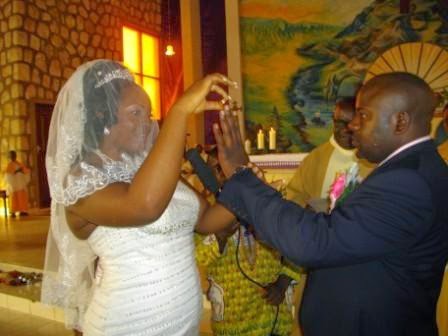
Gerard and Viannie’s journey into a new world ensued at the St John Catholic church with Reverend Father Robert Tantoh, assistant Secretary General of the National Episcopal Council in Yaounde leading the solemn wedding mass.
After several marriage rituals, the church was thrown in a joyous mood when the groom declared, “I do solemnly declare that I know not of any lawful impediment why I, Gerard Ngala, may not be joined in holy matrimony to Viannie Tah”.
In a show of unanimous approval of the union and acceptance to stand by the couple, the declaration was followed by a thunderous round of applause from the congregation.
The congregation would not sit when the bride said, “I Viannie Tah, do take thee, Gerard Ngala, to be my lawfully wedded husband, to have and to hold from this day forward, for better, for worse..., till death do us part”.
Gerard, take this ring as a sign of my love....Viannie
After declaring their consent before the church, the college of clergy then took turns to pray for God to bless and protect on the couple He had joined together.
In his homily, the Reverend Father Robert Tantoh stressed on the need for the couple to perfect each other in faith. “Through marriage, you become the man and woman God created you to be, so be committed to each other. Communicate the secrets of your hearts to each other, forgive each other,” Rev. Father Robert Tantoh urged the newlyweds.
With the 'big boys'

The grand reception

From the St John Catholic Church at Foncha Street, guests joined the couple at a reception at the Ayaba Hotel which was chaired by Dr Fuh Calistus Gentry, Minister, Secretary of State in the Ministry of Mines, Industries and Technological Development.
Newlywed arrive wedding gala venue
Successive speakers at the reception like Dr. Vitalis Ngala who spoke on behalf of the groom’s family, Mrs Tah Emilia and Mr Louis Mougbaram who both spoke for the bride’s family hailed the newlyweds for taking the bold leap in life. They pledged to always lend their support and experience to Gerard and Viannie.
Dr Fuh Calistus Gentry said Gerard’s wedding couldn’t be taken lightly because he (Gerard) is an asset to the Donga Mantung community. Besides being chairman, Dr Fuh announced he was also sitting in for several other people like Shey Jones Yembe who were unavoidably absent including.

CRTV top presenters as MCs

Highly sought-after CRTV ace talk show hosts Jimla Nene Shadzeka and Ivo Partem, who emceed the reception, gave their names and reputations a good representation as they served guests with the same expertise they are noted for on television.

Njang and makossa on stage

One of the most interesting parts of the wedding gala was the live performance of renowned music stars like Richard Kings, Narcisse Pryze, Sergio Polo and Papa Zoe. While Richard Kings thrilled guests with the Njang and his charming voic, Sergeo Polo and his popular hit, Solantine, got everyone on his feet. The groom who almost removed his wedding coat as he danced ‘spoiled’ the musician with bank notes to an extent that Sergio Polo himself almost missed his dance steps. ‘Farotage’ from Gerard and Viannie Ngala at the wedding gala almost got all artists unable to perform their own songs.
Gerard and his princess’ is a longstanding love story. Before Viannie and her prince charming said their ‘I dos’ they had been together for about eight years. Their union has been blessed with two kids. 
By Ndi Eugene Ndi, just back from Bamenda

Thursday, December 11, 2014

Senator Jikong Forever!

Yaounde, Cameroon--The remains of the late Senator Professor Jikong Stephen Yeriwa who died on November 15, 2014 have been coffined at the Yaounde General Hospital mortuary and conveyed to the University of Yaounde I for academic honours. He was 67.
The coffining took place in the presence of state officials and political personalities. Amadou Ali, Vice Prime Minister, Minister Delegate at the presidency in charge of Relations with the Assemblies led members of government. Others were CPDM central committee members, fellow senators, fellow university dons, Donga Mantung elite, as well as family members. He will be laid to rest on Saturday December 13 in his native Jator Village in Nwa subdivision (See photos).
.


Wednesday, December 10, 2014

MTN Has Lots of Everything on Offer at PROMOTE 2014

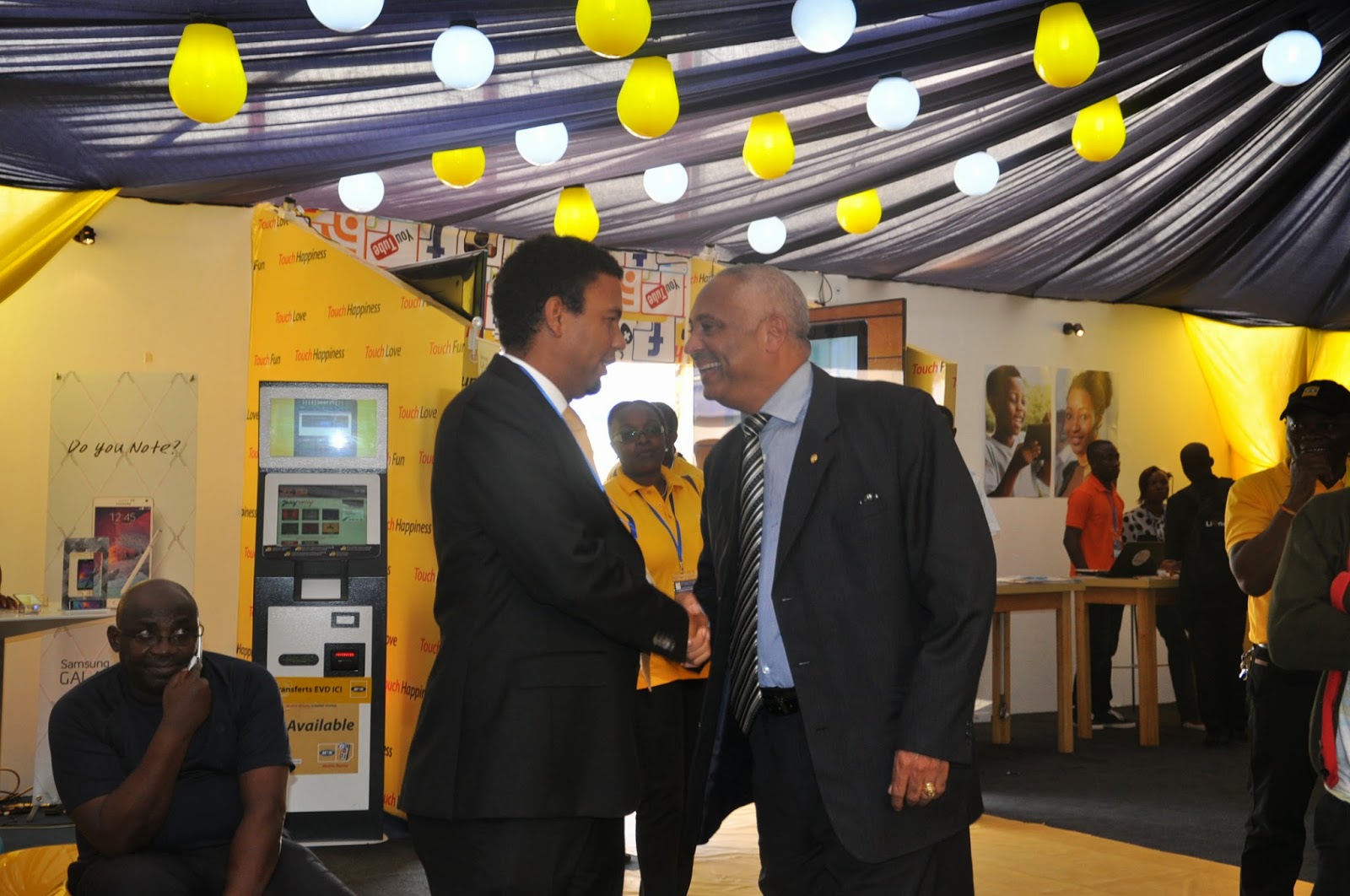
Yaounde, Cameroon—Cameroon’s leading mobile telephone service provider MTN has been ‘spoiling’ its customers and visitors at an imposing stand it erected at the heart of the  ongoing international  exhibition fair for enterprises, SMEs and partnerships dubbed PROMOTE 2014.
MTN Cameroon CEO Welcomes UIT Central Africa Representative
Present at PROMOTE for the 6th consecutive year, MTN officials say in showcasing their know-how, they are at their customers’ beck and call with a golden digital world to brighten their lives on offer.
The mobile telephone service giant’s connected home service is the most sought-after by customers. 
“It’s interesting to know that with your mobile phone you can control appliances in your home from your office.”
“Let’s say you go to your office and forget to turn off your TV, you can turn it off with your mobile phone and wimax technology. If you have your video surveillance camera you can rotate the camera and monitor what is happening in your house,” Massey N. Bongang, MTN Cameroon’s Corporate Communications Manager said.
Young people have repeatedly troupe around MTN’s stand and experiment with top notch services like M-health and M-education (M=mobile).
Massey Bongang explains that with mobile health, the user is able to control his/her health using the mobile phone. Meanwhile, mobile education offers users the chance to learn from just about everywhere with their mobile phones.
Customers enjoying connected home service
The MTN pay way kiosk, which at first view could be mistaken for an ATM, is a crowd puller as this reporter’s tour of the MTN stand with the company’s Corporate Communications Manager carries on.
“It is a mobile money pay way kiosk where customers recharge their MTN mobile money accounts without any assistance,” Massey explained.
With lots of everything on exhibition, MTN gives visitors and customers the opportunity to test certain devices and smart phones even before deciding whether or not they want to buy them. And what’s more, digital experts are on hand to advise them on the different types of phones and devices.
Perhaps the novelty this year is the MTN treasure home through which several visitors have already backed home different types of gifts.
Visitors test smart phones, other devices at MTN stand
 “MTN is offering all visitors to PROMOTE an exciting treasure home where interested customers participate where visitors who are able to gather the clues to a treasure, win great prizes that are given to them after a raffle draw at the MTN stand at 4:00 pm every fair day,” Massey said.
Though only four of the 80 that are permitted to take part in the draw go home with great prizes, all participants are compensated by MTN.
“Even if you don’t win one of the big prizes because you are not one of the four people who were drawn, as long as you participated right up to the end and got the right answer, you will go home with something from MTN”, the Corporate Communications Manager explained.

By Ndi Eugene Ndi in Yaounde

Tuesday, December 9, 2014

Anti-terror law will not curtail civil disobedience—Hon. Mbah Ndam

Yaounde, Cameroon—Many Cameroonians think the recently adopted law on the suppression of acts of terrorism by parliament deprives Cameroonians of their right to voice dissent. But reputed lawyer, legal adviser of the SDF, MP and Deputy Speaker of the National Assembly, Hon Joseph Mbah Ndam says that is not the case. Cameroonians need not be glum about the law as it does not restrain civil disobedience, strikes and street protests, he argues.
Hon. Joseph Mbah Ndam

With Cameroon being threatened by recurring Boko Haram onslaughts, Hon Mbah Ndam says the law will be a great boost to the fight against the terrorist group. Though he censured President Paul Biya for not acting on time to prevent terrorism, the MP thinks the law will undo the mess that the dreaded Nigerian sect has made of some parts of northern Cameroon.
The MP spoke to our reporter Ndi Eugene Ndi in Yaounde, read on
News Watch—Hon.Most Cameroonians are of the opinion that the recently adopted law by parliament on the suppression of acts of terrorism has killed their freedom. What is your take on this?
Hon. Mbah Ndam—I  think Cameroonians are justified in their apprehension because when you look back into the history of our nation, certain events have occurred which when you talk about any law on terrorism, it causes ghost pimples on the hands and faces of Cameroonians. We know of the 1962 ordinances, the 1972 ordinance on suppression of terrorism. These laws frightened Cameroonians when they think that they are about to be brought back because it is only when the SDF broke the ground in 1990 and launched another political party that we were able to have the liberty laws of that very December 1990 that abolished these dangerous laws in our nation. Prior to 1990, the military tribunal was a kind of tribunal because during the 6th April 1984 attempt to take over government by force, the military tribunal was a tribunal of exception; it tried people in the morning and executed in the evening and it sufficed for you to have been taxed of subversion before even 1984 for you to disappear. There were those laws that were used to crush the nationalists’ movements towards independence. So haven come out of that situation, everybody feels that this law is exactly that very situation, I want to beg to differ.
News Watch—What therefore is the content of this law?
Hon. Mbah Ndam—The content of that law is not what it is that Cameroonians are taking. It has not deprived Cameroonians of their right to public manifestation; it has not deprived political parties of holding public rallies and manifestations against evils committed by the government. It has not limited the right of anybody, so if this government misbehaves in torturing Cameroonians, or to suppress Cameroonians of their rights, it will not be because we voted this law. It will be that it is acting in its usual characteristics manner that it has cause Cameroonians to suffer over 32 years. When you read Section 1 sub section 2 of this law it says that the provisions of the penal code, the criminal procedure code and the military justice code are still applicable so far as they are not repugnant to this law. This means that it guarantees virtually all due process. Secondly, the military tribunal that exists in Cameroon today is no longer that murderous military tribunal of old.
News Watch—How is the military court of today different from that of old?
Hon. Mbah Ndam—Let me give an example, when we were clamouring that these laws should be repealed by Ahidjo, he never wanted until he was tried by them and he had to run Cameroon and die outside. Our fight since 1990 brought liberty and freedom and now if you were to be charged of offences provided by this law and you are to go before the military tribunal, one guarantee you have there first is that they are trained magistrates even though they are military people who are sitting there. Secondly any decision of theirs is subject to appeal to the regional court of appeal where you will have civil magistrates sitting. Any decision by that civil magistrate or the civil appeal court that does not satisfy you, you have the right to go to the Supreme Court and even if you are condemned to dead after the Supreme Court decision, there is still there is still the application for grace, for mercy by the head of state, so I want to say it is due process that exists. Secondly if you were to be arrested that you were marching, it must be proven that you were carrying out a terrorist act and what constitutes a terrorist act is a question of law, of international law. It is not just a mere murderer that becomes a terrorist; you must be proven that you have committed a terrorist act as defined by international law.  And all the terrorist organizations in the world are known, somebody must show that you belong to one of those terrorist movements.
News Watch—How does this law relate to Boko Haram?
Hon. Mbah Ndam—Book Haram has recently been recognized as a terrorist movement, so for you to be prosecuted in Cameroon, it must be shown that the acts you have performed are terrorist acts and that you belong to Boko Haram. So when I will wear my sache from here and ask my colleagues for us to go out into the streets and march against the rejection of our private members’ bill we will not become terrorists for that is not what terrorism means. So you see that if you and I agree, politics aside, that what is happening in the Far North region where terrorists are carrying incursions into the country where schools have not yet resumed, villages have been displaced, if we love our people, then those who are carrying out those acts should be punished and you cannot punish them when you don’t have a law.
News Watch—Are you insinuating that the law will rather serve us in the fight against Boko Haram?
Hon. Mbah Ndam—It will serve us greatly. For example, if I was to open my laptop, I will show you the world map for you to see how the world is fighting terrorism and that all indications of where terrorists are found are the concern of the world. Cameroon is not yet included because we had not yet ratified the conventions, as lazy as Biya is, one of the conventions dates to 1999, he has only sent it to us during this session because the shoe has pinched him. He thought that terrorism was an affair of other people. And we are not included in the realm of those who can seek international assistance in terms of fighting terrorism because we had no legislation for it. Times have changed, for us to fight that movement that is going up North, it will cost us a lot and this government is responsible because when we used to say that this country should developed equitably, they decided to concentrated resources only in certain areas. What is happening is that your illiterate brothers and sisters and the youths of the North who have been put under abject poverty; when you get into the Far North, you discover that fellow Cameroonians are living like animals. You find people whom all they own in their life are the small mat they hold in their hand that they can put somewhere and sleep. You find areas that they do not even know that they belong to Cameroon. But you have these big guns who come from there and parade here whereas the background is rottened. So when Boko Haram came and lured the people with a few francs, they have all drained into Boko Haram. And so we are fighting ourselves, we are fighting the children that we failed to educate. We are sending our army to go and kill or get killed by some us who have now joined Boko Haram. This fight can go on for years for it is not a conventional war, they are attacks by ambush. And for how long will that last; so if you don’t make laws that take care of terrorist movements like that so that it is a consummate; world action and assistance, this thing can destroy the whole of Cameroon.
News Watch—Are you saying with the voting of the law, Cameroon will now benefit foreign support in the fight against Boko Haram?
Hon. Mbah Ndam—Absolutely yes, the first benefit is international investigation. To be able to identify the culprits, the organizations, we need a police force that is better than the micro thing that we have in Cameroon. You must be able to go across borders and see how Boko Haram is linked to the other terrorist organizations and to Al-Qaeda, which we cannot do. Therefore at what point can you break the link in order to know to what extend you can fight. You need international cooperation, it is not that fanfare that you saw Biya and the rest go to France and see Hollande…it is far beyond that. Cameroonians shouldn’t become cowards for this law does not stop civil disobedience, it does not stop strikes. This law punishes terrorist acts and terrorist acts are known in the world. It is not because we will fight on the ballot box that somebody will be treated as a terrorist. It is not because we will fight as a result of somebody frauding at an election that you will be termed a terrorist. The law does not qualify to try such cases; those are electoral malpractices which are in the law not this law.
News Watch—So will you tell Cameroonians that this law has not come to mess their freedom?
Hon. Mbah Ndam—The law has come to stop the mess that Biya has created for us over 32 years and not to mess them.